

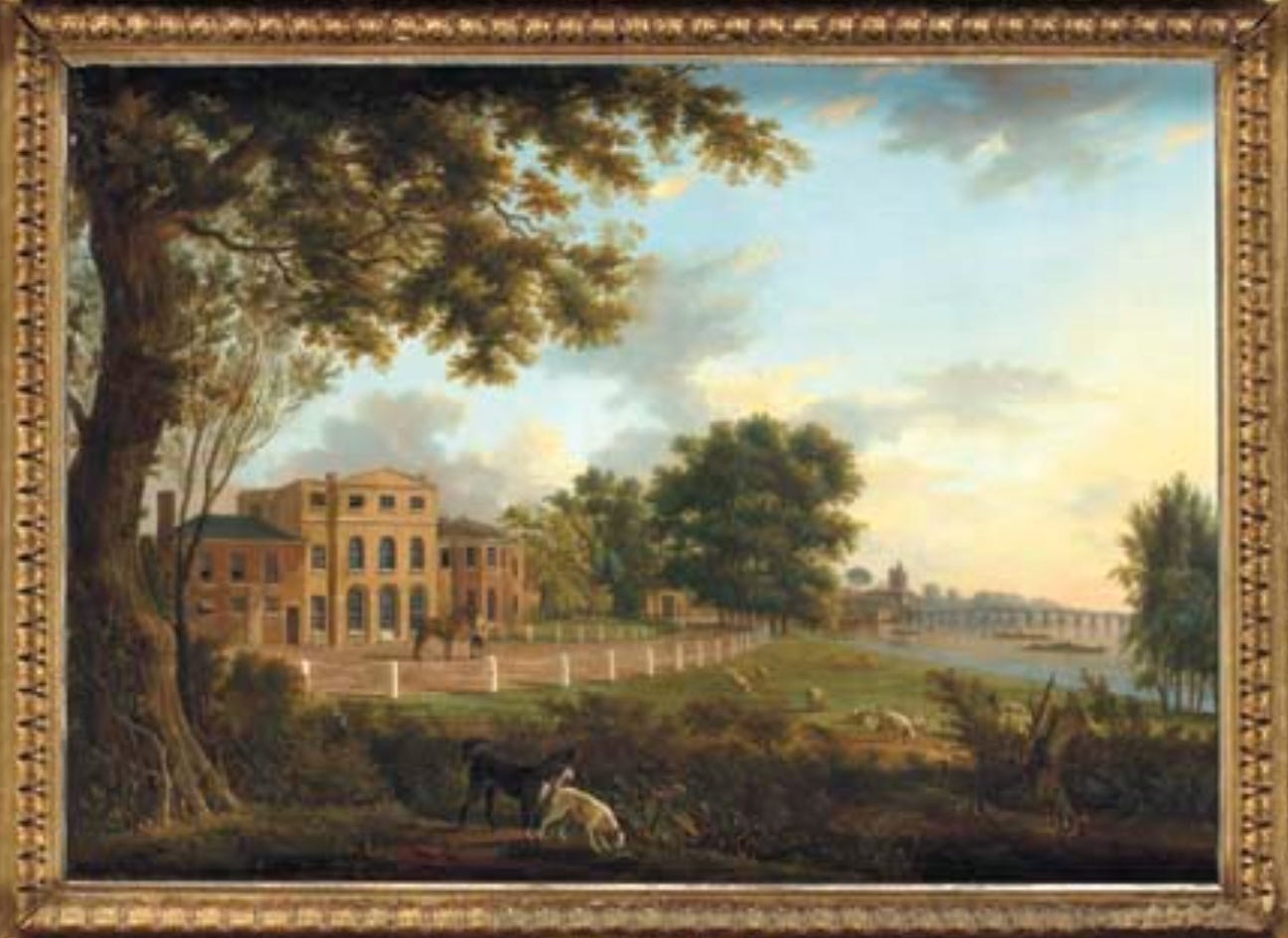
Chelsea Farm, the Thames and Battersea Bridge, Hendrik Frans de Cort (1742-1810) All rights reserved Christies Inc.
Seeing the World Differently
On a rainy day in London, everything feels more alive.
The air sharpens. The trees deepen into a particular shade of green, one that feels almost exclusive to this city. Slightly opaque, softened by moisture, reflecting light in a way that reveals their texture, movement and presence. I often walk along Chelsea Bridge Road under an archway of trees that form a natural corridor, and yet it never feels repetitive.
I notice something new each time. Patterns, mostly.
Connections between things that don’t seem related at first. The green of the trees echoing the colour of children’s school uniform. That same tone appearing, years ago, in my grandparents’ home, darker, more mossy, but undeniably linked. Threads across time and place that somehow belong to the same story, my story.
I’ve always been drawn to that instinct to connect: people, places, memories, feelings, ideas. To sense that what surrounds us is rarely random, even when we don’t yet have the language to explain it.
There is so much embedded in our everyday lives that we simply don’t attune ourselves to. When you begin to notice, it feels as if another layer of reality reveals itself. In textures, reflections or the rhythm of movement around you: a leaf holding droplets as light passes through, puddles shifting with each drop of rain, people moving, some rushing, others steady, all part of a shared choreography. Like light pouring through a chapel window, refracting the city light into geometric fragments as it enters, arriving inside as something softer, coloured, and alive.
This way of seeing isn’t something you acquire artificially. It’s not a pill or a hack. It’s how your mind captures the world when your internal antenna is tuned not only to your surroundings, but to who you are within them.
Humanity Lives in the Ordinary
Our existence is not individual, no matter how much we are taught to behave as if it is.
We live as if we are separate, but in reality we are deeply interconnected, through systems, relationships, and shared experiences. We move through similar cycles: we celebrate birthdays, we work, we rest, we buy and sell, we struggle, we pay bills, we raise children, we rely on one another far more than we admit.
And yet, we forget that exercising our humanity is not only about big things: charity, war, conflict, political outrage on social media. It’s also about the smallest movements of attention: Eye contact. Presence. Intuition.
It’s the ability to look at the person beside you and offer an optimistic angle on life, however small. Sensing how someone feels without a long explanation. A short exchange with a stranger that unexpectedly brightens your day. A moment of genuine connection that gives you perspective and reminds you that you are human, and so are they.
That is where humanity lives, in the ordinary.
Living in a Mediated World (Without Losing Yourself)
At the same time, we are moving deeper into a culture where much of our experience is mediated by technology, platforms and algorithms. AI is increasingly involved in what we see, what we choose, and even how we think. There is incredible possibility in that, but also risk.
We document instead of experience. We perform instead of feel. We share instead of absorb. I say this as someone who genuinely loves social media. I use it every day. I scroll, I laugh at silly videos, I repost, I share moments of stupidity and joy. I don’t stand outside it, judging. I’m in it.
But I’m also aware of the noise. The issue isn’t the tools themselves; it is our relationship with them. We don’t need to exclude social media, stop spending, or throw away the dress that made us feel something. That’s not the point.
We don’t need to stop. We need to become aware. Aware of what we’re doing. Why we’re doing it. When, and how. Aware of what we’re feeding our minds with. I apply this in simple, practical ways. I don’t ban screens for my son, I guide them. I choose what he watches. I limit time. If his behaviour is off, the screen goes away. Some games are just not allowed. And if I can do this for my child, I should be able to do it for myself.
Awareness is not an abstract ideal. It’s a daily practice.
Neurodivergence and the Myth of “Being Like Everyone Else”
My own brain works in a way that doesn’t always fit the script.
My memory, for example, is unreliable in the conventional sense: I often can’t recall what I ate two days ago. But give me an old journal entry from ten years ago and I can follow that thread back into every detail of that moment. My recall is patchy and precise at the same time.
That’s neurodivergence for you: non-linear, inconvenient, but often powerful.
And our brains are not all wired the same way. So how can we expect our lives to look the same? How can we expect to behave, work, mother, love, create and exist like everyone else?
If you’re trying to do that, you’re wasting your time.
For a long time, I tried to be “more”: more productive, more accomplished, more of what I thought others wanted me to be. Underneath it, there was a simple desire to be seen and loved for who I am.
So I took on things that didn’t belong to me. I tried activities I was never truly interested in because they looked like the “right” kind of ambition. I pushed myself towards versions of womanhood and success that were inherited rather than chosen.
At some point, I had to reconcile with the fact that family and motherhood, for me, would never look like they did for my mother.
And in making peace with that, I realised I was not only giving myself permission. I was also, in a small way, giving it to other women of my generation.
Redefining Womanhood on Your Own Terms
We are likely one of the first generations of women taking the world on our own terms at scale.
There have always been strong, independent women in history and in our lineages, women who stood in rooms dominated by men and held their ground. The women in my family did that. I’ve done that too.
But there’s a difference.
I left my parents’ home and country to build a life defined by my own choices. That came with an opportunity, and a responsibility, to rethink the “default by design.” To challenge what didn’t work for me. To accept who I am and how I deal with what matters to me as a woman.
To acknowledge that expectations set for me elsewhere are not the expectations I necessarily set for myself.
Making peace with that has been revolutionary. Because instead of working to fulfil an invisible contract with society, I rewrote the contract with myself.
Every clause now is based on what I believe, what I stand for, and where I want to go.
Isn’t that liberating?
I don’t think I would have done this with such freedom and ease in any other timeline. I am lucky enough to be part of a generation of women who are signposting historical acts in real time, through our own personal charters. We may not all be in history books, but we are rewriting norms in our kitchens, studios, offices and WhatsApp chats.
Purpose as Reconciliation, Not Performance
Underneath all of this, one question keeps returning: what are we actually searching for?
We are all in search of something. Short-term or long-term, we all have a problem to solve, a hard situation to carry, a piece of ourselves we don’t fully understand yet. We all experience some degree of pain, whether small, big or huge. None of us is exempt; it’s part of the deal of being human.
We are not here forever. We don’t get to linger into eternity. We don’t know when everything stops. So perhaps our real quest in this life is to decode and understand ourselves.
To ask: What is it that I need to do in this life? Not in a performative, productivity sense, but in a reconciliatory one.
Purpose is not just ambition, it is also reconciliation.
Reconciliation with everything that came before. With every version of you that tried, failed, adapted, survived. Every step, every layer of your story still exists within you, waiting. Not outside. Inside. Waiting for you to unlock it, to step into it.
There is no magic pill. No perfect or special wiring that exempts anyone from this work. I’m not asking you to repeat affirmations or rewrite your life in ten bullet points.
We don’t become through repetition. We become through recognition, of who we already are, and of the life that has been waiting for us to claim it. And this is a process. A never-ending one…
Some days you will feel like you’re living outside your body, dissociated, misaligned, lost. Sometimes that’s just a bad day. Sometimes it’s a crisis. And then, like the movement of the water on the Thames, everything shifts again. One day the surface is chaotic, disturbed by different forces. The next day it settles, flat and reflective.
That rhythm is happening inside us too. We wake and we sleep. We expand and contract. We are thrown into chaos, and then we come back to some kind of calm.
Resonance: When Your Life Finally Feels Like Yours
There is a word that helps me make sense of this: resonance.
In physics, resonance happens when something vibrates at a frequency that matches another. When waves align, they amplify one another; energy gets organised, intensified, directed. Time, movement and structure begin to work together instead of against each other.
The same is true internally.
When your inner life and your outer life start to resonate, when your values, your actions, your relationships and your environment begin to align, even imperfectly, something shifts. Things feel less forced. Movement feels more natural. Time feels less like a race and more like a rhythm.
Resonance is not a permanent state. It’s something you return to, like your breath. Like the walk you take on a rainy London day, when the trees are green and the city feels, for a moment, absolutely in sync with who you are becoming.
We don’t get to control everything. We don’t get to stay forever.
But we do get this: the chance to recognise ourselves, to rewrite our own contracts, and to live, as neurodivergent, complex, evolving women, on our own terms.
Not perfectly or neatly. But honestly. :D
Happy Tueday,
M