

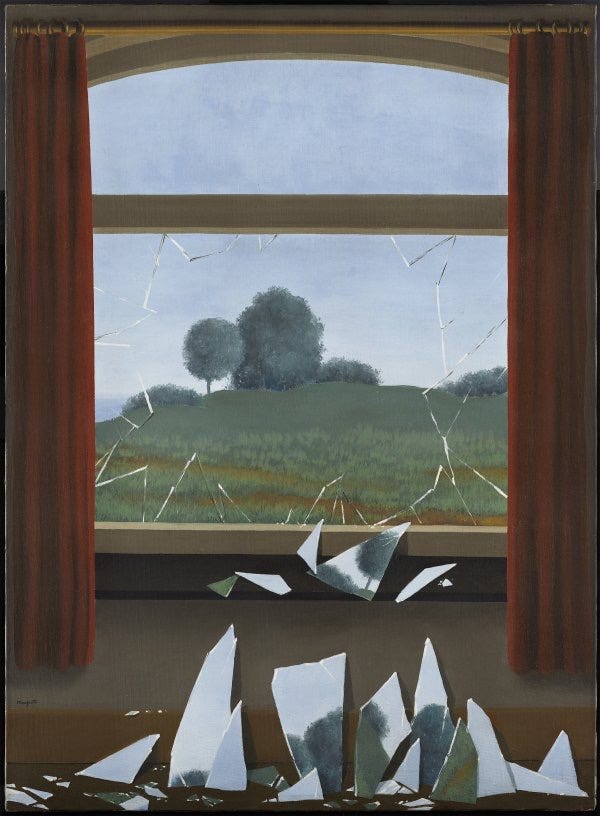
I have listened to this song for years, but lately I keep returning to the plastic tree. It has the shape of a living thing, without the inconvenience of actually being alive. It requires no light, no changing seasons, no room to grow. An interesting ideal, when you think about how we judge one another.
Recently, I was called a “lost child” by people who knew my history. I have been trying to understand what that means. Lost in relation to what? A destination I was meant to reach? A version of myself that would have been easier for others to recognise?
I was a much-wanted child, born after my mother had endured repeated losses. I grew up with severe myopia, repeated eye procedures, absence epilepsy and a neurodivergent mind that schools had little understanding of. I suffered with bullying, family grief and emotional insecurity. But there was also imagination, affection and the freedom to invent entire worlds in a Brazilian backyard.
At 27, I moved abroad without knowing anyone. I built an unexpected career, travelled alone across the globe and eventually became a mother in a language I did not speak. There have been mistakes, contradictions and periods when I struggled to understand myselff. I am not interested in editing those out.
What unsettled me was not that others saw me differently. It was discovering that experiences I had shared in trust could later be used to question my judgement. There is something profoundly contradictory about encouraging vulnerability and then treating it as evidence of inadequacy.
We celebrate resilience in retrospect, but seem less comfortable with the complicated, unfinished human being who has had to practise it.
Perhaps that is the attraction of the artificial tree. It looks complete. Nothing grows out of place.
I am not a lost child.
I am the child who was called a problem long before anyone thought to question whether the problem might lie in the institutions entrusted with her development. Whose unconventional way of learning was mistaken for an unwillingness to learn, and whose curiosity rarely fitted within the narrow margins of conventional education.
I am the child who defended her thoughts and convictions, sometimes clumsily, sometimes against her own interests, but always with an instinctive resistance to accepting something merely because it was universally accepted.
I am the child who learned that being different could invite judgement, and that belonging sometimes came with an impossible to fulfil expectation of self-erasure.
I am the child who grew into a young woman fascinated by the unfamiliar. Who crossed continents in pursuit of experiences that once existed only in her imagination, dreaming of writing, travelling and collaborating with extraordinary brands and hotels in extraordinary places.
I am the child who discovered that ambition rarely follows a linear trajectory. That reinvention is not necessarily evidence of indecision, but sometimes the consequence of discovering possibilities that were previously beyond one’s imagination.
I am the child who came to understand motherhood not merely as an expression of love, but as an encounter with the responsibility of shaping another person’s earliest understanding of the world. Of recognising how profoundly our words, silences and emotional responses can inhabit another human being long after childhood has passed.
I am the child who began advocating for the right of others to exist on their own terms. For children whose minds develop differently, whose questions resist easy answers, and whose potential should never be measured solely by their capacity to conform. For truth and justice, diversity and equality!
I am the child who encountered closed doors, disappointments and the disorienting experience of having her intentions repeatedly misunderstood. Who slowly came to recognise that rejection, however painful, is not necessarily an accurate reflection of one’s worth.
I am the child who learned that compassion does not require the abandonment of discernment. That understanding another person’s suffering does not oblige us to accept the suffering they may inflict upon us.
I am the child who found, amid the ruins of certain expectations, an appreciation for her own company. Who began to understand that solitude and loneliness are not synonymous, just as being surrounded by people is no guarantee of belonging.
I am the child who has loved imperfectly, forgiven perhaps too readily, questioned herself relentlessly and continued searching for meaning in circumstances that offered very little explanation.
I am the child who refused to let adversity become the organising principle of her existence.
Who found refuge in music, fashion, literature, art, curiosity and the inexhaustible complexity of systems and human nature.
Who learned that tenderness can coexist with conviction, that sensitivity need not be mistaken for fragility, and that a questioning mind is not necessarily a troubled one.
I am the child who still believes in the possibility of goodness without requiring the world to be innocent.
I wish I could be who you wanted all the time
I am beginning to understand redemption differently. Not as proving my innocence, establishing someone else’s guilt or rewriting my past into a more acceptable narrative.
Rather, as reconciling with the person I have been, including the parts of myself I once believed needed correcting.
I still believe in compassion, in love, in people’s capacity to change. Perhaps more importantly, I am learning that understanding others need not come at the expense of understanding myself.
Real trees lose their leaves. They bend towards the light. Their shape is a record of the conditions in which they have grown.
And perhaps that is what I have come to appreciate about my own life.
I was never lost. I was becoming someone I had not yet learned to recognise.
Love,
M