

The Sentence That Took Me Back to Brazil
I came home tonight carrying a sentence I wish I had never heard.
A young girl was insulting a woman of colour and her daughter in the bus as I walked in. At one point, she said something like:
“Nobody cares for your kid.”
There was something profoundly disturbing about those words. Not simply their cruelty, but the ease with which they were spoken, as though another person’s dignity, or the worth of their child, could be dismissed so casually.
And somehow, they took me back to Brazil.
Three days ago, on 25 October 2026, Luiz Inácio Lula da Silva won the Brazilian presidential election for the fourth time, bringing Brazil to the centre of international political discussion.
I am Brazilian. Yet, for much of my life, I grew up strangely detached from what being Brazilian really meant.
There is the Brazil the world recognises: beaches, football, music, carnival and an extraordinary warmth of character. Then there is another Brazil, where poverty is inherited, opportunity is unequally distributed, and millions of people work relentlessly simply to survive.
And yet, some of the most generous people I have encountered are those who have the least to give.
Ask a Brazilian for help and, more often than not, they will offer a smile before they offer an answer.
But I did not grow up knowing that Brazil.
Or perhaps I did, without really understanding it.
The Comfort of Not Knowing
As I lie in my comfortable king-size bed in central London, I find myself remembering the house where I grew up in Rio Grande do Sul, in the agricultural heartland of southern Brazil in the 1990s.
It was a large house, with most of our everyday life unfolding on the main floor, between the kitchen, living room and bedrooms. Downstairs, an enormous basement doubled as our television room, while a terrace overlooked the surrounding fields. Our dog barked in the garden, bicycles lay scattered around the garage, and mum’s car was always ready to take someone somewhere. From the kitchen’s enormous windows, we could see the fruit trees in the backyard and watch the seasons change.
I remember the wooden floors creaking beneath our feet, the long rainy afternoons and the thunderstorms I adored, when the sky darkened and rain poured down in sheets. During winter, we fed logs into the cast-iron stove and fireplace to keep the house warm. A gas heater stood in the living room, with smaller electric heaters scattered around the bedrooms, although nothing quite compared to the warmth of a wood-burning fire.
People imagine Brazil as a perpetually tropical country, but winter in Rio Grande do Sul is a peculiar beast. The cold gets into everything, and the humidity makes even London’s gloomiest winter days seem almost dry by comparison. Yet inside, the house remained warm and cosy, filled with familiar sounds.
Our house was not extraordinarily luxurious. It was comfortable. We had food, warm beds, education and security.
I never thought of any of that as exceptional.
That was precisely the problem.
Privilege is most effective when you don’t recognise it as privilege.
The Racial Hierarchies We Learn Without Being Taught
At school, there were very few Black children. I was among the “darker-skinned” children in my own classroom, and I did not have a Black classmate until high school.
Looking back, that alone tells me something about the environment in which I grew up.
It was a predominantly white world, where European ancestry functioned almost as a social credential.
Yet racial prejudice existed everywhere, even in spaces where Black people were almost entirely absent.
Expressions such as nega véia, neguinha, cabelo Bombril and negradinha formed part of everyday vocabulary. Sometimes presented as affectionate nicknames, sometimes unmistakably derogatory, they were repeated so casually that few people appeared to question them.
Children attending public schools were automatically associated with poverty, as though the institution where you studied determined your social worth.
And in the predominantly white society of southern Brazil, looking mildly European could also carry an unspoken assumption of superiority.
The extraordinary thing about prejudice is that nobody necessarily needs to teach it explicitly.
Children absorb it.
They learn who belongs, who serves, who deserves respect and whose circumstances are considered unfortunate but perfectly normal.
I began questioning these assumptions only after leaving Brazil and living in a London neighbourhood with a large African immigrant community.
Distance made familiar things look strange.
And the longer I lived away, the more I began questioning the social hierarchies I had grown up accepting.
Compassion, Class and the Privilege of Walking Away
I remember Indigenous families living in precarious circumstances. They were spoken about as communities we should feel compassion for, almost as though their displacement were a natural condition rather than something deeply connected to the country’s history.
In my family, charity was part of our upbringing, influenced by a European Catholic tradition of social responsibility.
Some people practise charity because it is socially expected. Others because they genuinely believe in helping.
I was fortunate to grow up around the latter.
I remember my grandmother preparing lemonade for the builders renovating her house and inviting them to eat food from our family table.
I remember people visiting my grandfather to ask for help, and him helping them.
I remember my mother filling the boot of our car with supplies to distribute to families living in a vila on the outskirts of our hometown.
In Brazil, a vila can mean something quite different from the luxurious villa one might imagine in Marbella.
The vila I remember was a place of devastating poverty.
The roads were unpaved, little more than compacted mud and stones, with enormous holes along their edges.
Some homes were assembled from wooden boards, with gaps so large that daylight and cold air passed through them.
No proper insulation. Sometimes barely a floor.
I remember looking at those structures and trying to imagine what it must feel like to sleep inside them when winter temperatures approached zero.
I couldn’t.
My mother would unload what Brazilians call a cesta básica: essential household supplies, from rice and flour to cooking oil, soap and toothpaste.
I watched, disturbed by the conditions in which people lived.
But then we returned home.
Back to the warmth. Back to my bedroom. Back to the somewhat security of knowing this was my place to be.
My parents wanted me to understand that not everyone lived as we did.
And I am grateful for that.
But I have since realised that seeing poverty is not the same as understanding it.
Charity can fill someone’s pantry for a week. It cannot, on its own, dismantle the structures that leave that pantry empty.
I was a visitor to a reality I could leave whenever I wanted.
That is something privilege rarely requires us to confront.
It is not simply having more.
It is having the freedom to walk away.
The Brazilian Art of Surviving Scarcity
Growing up, we heard stories about children in Brazil’s northeastern region, the Nordeste, dying from hunger, living without adequate healthcare or access to education. Children that were put to work at age 6.
These were stories of a distant Brazil, despite being part of the same country.
Extreme poverty does more than deprive people of material necessities. It determines possibilities, shapes expectations and passes disadvantages from one generation to the next.
Scarcity becomes embedded in family histories and institutions.
Perhaps that helps explain the famous jeitinho brasileiro.
That uniquely Brazilian art of improvising, negotiating and finding a way to make something work when the circumstances seem impossible.
It is often celebrated as creativity and resilience.
But how much of that ingenuity is born from necessity?
What happens when generations grow up learning that systems cannot always be trusted, institutions do not always deliver, and survival depends on finding another way?
We celebrate resilience without always questioning the conditions that make it necessary.
And resilience should never become an excuse for inequality.
Neurodivergence and the Inequality of Opportunity
I think about this in relation to neurodivergence, too.
Being neurodivergent and growing up in a middle-class household, with access to education, healthcare and financial security, is profoundly different from being neurodivergent in a favela or vila.
One child may receive a diagnosis, specialist care and educational support.
Another may spend an entire lifetime being labelled difficult, incapable or lazy, without anyone recognising what they need.
The neurological differences may be comparable.
The consequences of living with them can be worlds apart.
That is not simply inequality of opportunity.
It is inequality in the freedom to become who you are.
Lula’s 2026 Victory: Beyond Left and Right
And it brings me back to Lula.
When he secured his fourth presidential victory, defeating Flávio Bolsonaro, the international conversation naturally turned to political polarisation and the future of Brazil.
But my mind went somewhere else.
I thought about the millions of Brazilians who wake before sunrise, endure exhausting journeys to work, sometimes hold several jobs and return home to do it all again.
I thought about people for whom politics is not an intellectual exercise, but something that shapes whether their children have enough to eat, whether they can afford medicine and whether their communities receive basic infrastructure.
For me, Lula’s victory represented something beyond the contest between left and right.
It brought renewed attention to people whose lives are constantly discussed politically but rarely understood personally.
That does not mean every working-class Brazilian voted for Lula, or that one election can resolve centuries of inequality.
But it reminds me that economic policy is never abstract to the people living with its consequences.
There are things those of us who have lived with privilege may never fully comprehend.
Sometimes it takes leaving the environment that protected us to recognise how profoundly it shaped our understanding of the world.
Cazuza and the Future That Keeps Repeating the Past
And perhaps that is why I have always loved Cazuza.
He was one of Brazil’s most extraordinary artists. Irreverent, provocative, vulnerable and fiercely intelligent.
He, too, came from privilege.
But he could not comfortably fit the mould society had prepared for him.
His sexuality, his defiance of convention and his refusal to make himself acceptable placed him in conflict with the very social order from which he had benefited.
He understood that privilege did not necessarily protect someone from exclusion.
And he used that contradiction as artistic ammunition.
In O Tempo Não Para, written with Arnaldo Brandão, he confronted the hypocrisy, corruption and absurdity of a country seemingly destined to reinvent its old injustices.
A swimming pool full of rats. Ideas disconnected from reality. A future repeating the past, a museum displaying the same old problems as though they were novelties.
And through it all, the defiant refrain:
O tempo não para.
Time does not stop.
The electric guitar, the relentless drums, the rawness of his delivery. There was something almost Bowie-like about his irreverence.
Yet Cazuza was unmistakably Brazilian. He died from AIDS in a time AIDS had no cure.
He could be loving and furious, romantic and confrontational, cynical and painfully hopeful within the same song.
He challenged a society that labelled people before listening to them.
And what makes his music extraordinary is how little of it feels confined to the period in which it was written.
The corruption. The hypocrisy. The social hierarchies. The performance of progress.
The future repeating the past.
I listen to him today and wonder how many of the questions he raised remain unanswered.
Perhaps that is what great artists do.
They reveal things about a society before that society is prepared to acknowledge them.
What If the Future Doesn’t Have to Repeat the Past?
But this election made me consider another possibility.
What if the future does not always have to repeat the past?
What if the people who have spent generations being told to know their place become impossible to ignore?
I am not naive enough to believe that elections can erase centuries of inequality.
Nor do I believe political leaders should be placed beyond scrutiny because their stories resonate with ordinary people.
But I do believe there is something powerful about a society being confronted with the question of whose lives matter in its vision of progress.
Belonging, Humanity and the People Who Care
I left Brazil and built a life elsewhere.
I became more independent, more critical and perhaps more capable of recognising the things that had been invisible to me growing up.
Yet sometimes all it takes is the sound of rain against my London window to bring me back to that wooden house in Rio Grande do Sul.
I remember the stove, the creaking floors, the warmth of my grandparents’ home and the cobbled streets of my hometown.
I remember the security I took for granted and the deprivation I could never quite comprehend.
And I realise that understanding where you come from is not necessarily about celebrating the place that raised you.
Sometimes it means questioning it.
Sometimes it means admitting what you didn’t see.
Sometimes it means recognising that the country you thought you knew was only the small part of it you were fortunate enough to inhabit.
And tonight, after witnessing that exchange between a young girl and a mother in London, I realised something else.
Prejudice is not confined to the country we come from, the language we speak or the economic circumstances in which we grow up.
It travels across borders, survives generations and finds new ways to express the same old conviction that some people matter less than others.
Perhaps that is why those words disturbed me so deeply.
“Nobody cares for your kid.”
I don’t know anything about that woman or her daughter. I don’t know what their lives look like, where they come from or what they have endured.
But I know that no mother should have to hear those words directed at her child.
And I know that the worth of a human being should never depend on how wealthy they are, what colour their skin is, where they were born or how comfortably they fit into somebody else’s idea of belonging.
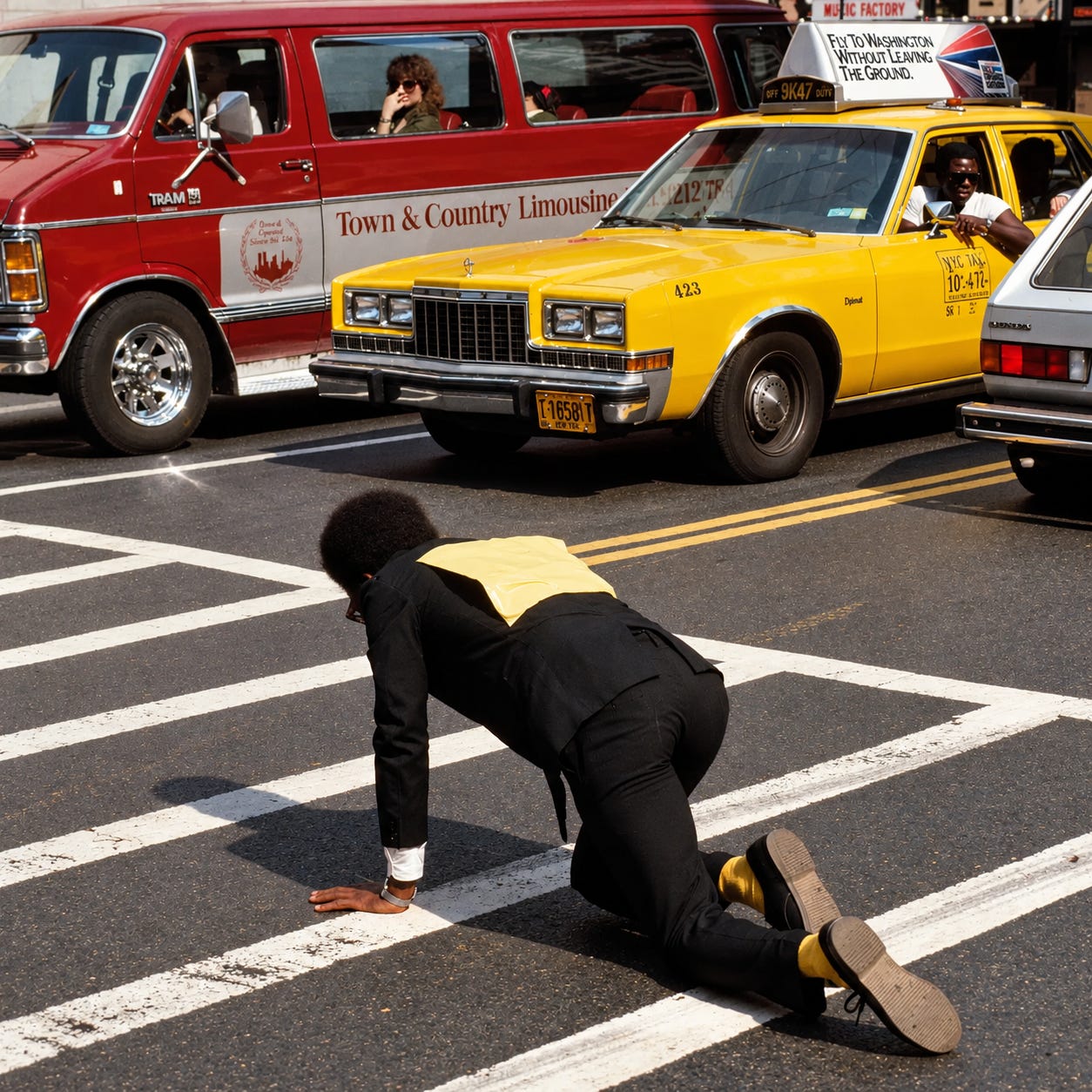
I began writing about Brazil tonight because I was reminded of how easily people learn to look down on one another hence why Pope L. crawling across Manhattan opens this essay.
But I also remembered my grandmother’s lemonade, my grandfather’s generosity and my mother’s car full of “cesta básica”.
Small acts, perhaps. Imperfect answers to much larger injustices.
But evidence, nevertheless, that we can choose to treat people differently from the way society has taught us to.
I had to leave Brazil to begin understanding what it means to be Brazilian.
And perhaps I had to witness that moment in London to remember something I should never have forgotten.
To the young girl who left bus 44 at Battersea Park, Chelsea Gate today and told that mother nobody cared for her child, I have something to say.
I can tell you, my friend, there are a lot of people who do care.
And I am one of them. 💕
M.
O texto me levou para as tardes que brincávamos no porão da tua casa e faziamos trabalhos de geografia. Realmente fomos - e somos - privilegiadas. Compartilho muito das tuas palavras. Alias.. Tua escrita é linda. Amo ler o que tu tens a contar. ❤️